Succulent Overwatering vs Underwatering: How to Tell the Difference
Published Date:
Succulents are beloved by plant enthusiasts worldwide for their striking geometric shapes, unique textures, and their reputation as low-maintenance houseplants. However, despite their hardy nature, succulents have one major vulnerability: their watering schedule. More specifically, finding the perfect balance between giving them too much water and not enough water can be a significant challenge for both beginners and experienced plant parents alike.
The struggle to keep these drought-tolerant beauties thriving often leads to a common crossroad: succulent overwatering vs underwatering. Because succulents store water in their fleshy leaves and stems, they communicate their hydration levels through physical changes. Unfortunately, the symptoms of having too much water and having too little water can sometimes look surprisingly similar to the untrained eye.
In this comprehensive guide, we will explore the critical differences between an overwatered and an underwatered succulent, the telltale signs to look for, and the precise steps you can take to rescue your beloved plant before it’s too late. Whether your succulent is dropping leaves, looking shriveled, or turning yellow, understanding these vital signs will transform you into a confident succulent caretaker.
The Delicate Balance of Succulent Hydration
To truly master succulent care, it helps to understand how these plants function in their natural habitats. Most succulents originate from arid, desert-like environments where rainfall is scarce but heavy when it does occur. To survive long periods of drought, they have evolved specialized tissues in their leaves, stems, and roots that act as water reservoirs.
When you water a succulent, its root system rapidly absorbs the moisture, and the plant plumps up its leaves to store the water for future use. Once the soil dries out completely, the plant relies on these internal reserves. This biological adaptation is why succulents prefer a “soak and dry” method of watering.
The primary cause of succulent distress in indoor environments is a disruption of this natural cycle. Overwatering occurs when the soil is kept consistently moist, suffocating the roots and causing the plant’s cells to burst from excess water pressure. Underwatering happens when the plant exhausts its internal reserves and the roots have no external moisture to draw from, leading to dehydration and tissue damage.
Understanding this balance is crucial. A succulent can endure severe drought much better than it can survive a swampy pot. This fundamental rule of thumb should guide your watering habits. If you are ever in doubt about whether to water your succulent, it is almost always safer to wait a few more days. For a deeper understanding of how seasonal changes affect watering, you can read our guide on indoor plants winter watering.
Telltale Signs of an Overwatered Succulent
Overwatering is the number one killer of indoor succulents. Because these plants are designed to hoard water, continuous exposure to soggy soil causes their cells to literally drown. Recognizing the early signs of overwatering is critical because the damage progresses rapidly and can quickly become irreversible if left untreated.
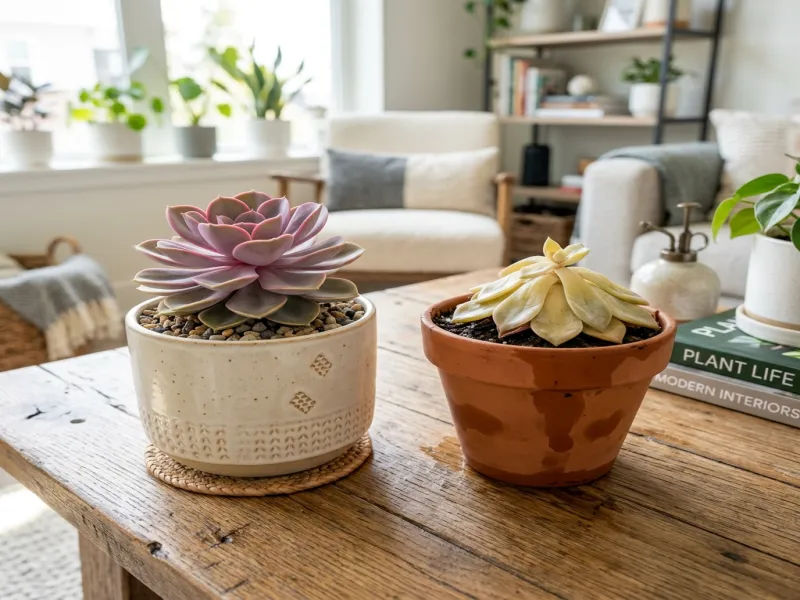
The first and most obvious sign of an overwatered succulent is a change in the texture and color of its leaves. Healthy succulent leaves should feel firm, rigid, and plump. If you gently squeeze a leaf and it feels soft, mushy, or squishy, your plant has absorbed too much water. The structural integrity of the leaf is breaking down because the plant’s cell walls are rupturing.
In addition to becoming mushy, the leaves of an overwatered succulent will often turn translucent or pale yellow. They take on a waterlogged appearance, almost as if they are made of a soft gel rather than solid plant tissue. These discolored leaves are usually located near the bottom of the plant, closest to the wet soil, but the rot can quickly spread upward.
Another unmistakable symptom of overwatering is rapid leaf drop. While it is normal for a succulent to occasionally shed an old, dried-up bottom leaf, an overwatered plant will drop leaves at an alarming rate. Even a slight bump or gentle touch can cause these mushy, translucent leaves to fall completely off the stem.
If the overwatering has been ongoing, you may notice the stem turning black or dark brown, starting from the soil line and creeping upwards. This is a severe indication of stem rot, a fungal infection that thrives in wet conditions. If the rot has reached the stem, the root system is likely already compromised. If you suspect your plant is suffering from this advanced stage, we highly recommend reading our dedicated root rot recovery guide for intensive care instructions.
Telltale Signs of an Underwatered Succulent
While overwatering is more common, underwatering is still a significant issue, especially during the active growing season. Fortunately, underwatered succulents are generally much easier to save than overwatered ones. Because they are built to withstand drought, succulents can bounce back remarkably well once their thirst is finally quenched.
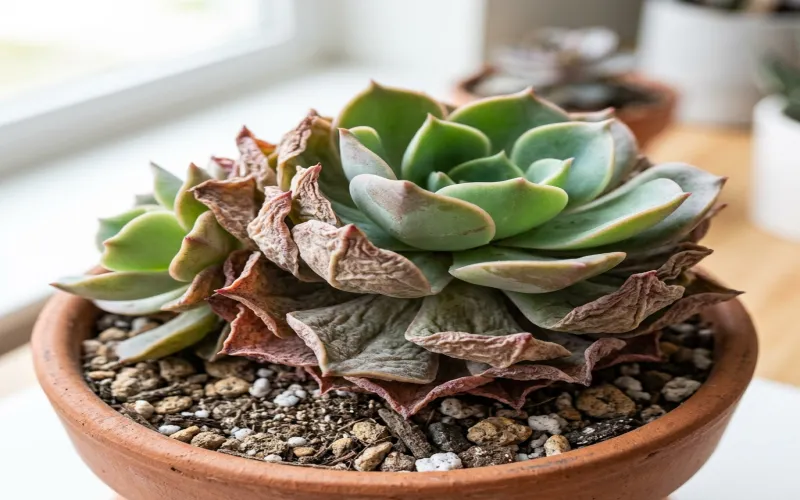
The most prominent indicator of an underwatered succulent is a change in the surface of its leaves. As the plant depletes its internal water storage to survive, the leaves will begin to look deflated, flat, and thin. Instead of being plump and smooth, the surface of the leaves will become wrinkled, puckered, and shriveled. It closely resembles a grape slowly turning into a raisin.
Unlike the mushy and soft texture of an overwatered leaf, an underwatered leaf will feel leathery, flexible, and dry. The plant loses its natural turgidity, meaning the leaves will bend easily without snapping.
As the dehydration progresses, the edges and tips of the leaves may begin to turn brown, crispy, and brittle. The plant is strategically abandoning its older, lower leaves to conserve what little water it has left for the newer growth at the center or top of the rosette. You will notice these lower leaves drying out completely and becoming paper-thin before eventually falling off.
An underwatered succulent may also exhibit a dull, muted color, losing its vibrant green or vibrant pastel hues. The plant goes into survival mode, pausing its growth entirely. If your succulent hasn’t grown in months and its leaves look like they need a good ironing, dehydration is the likely culprit.
How to Save an Overwatered Succulent
Saving an overwatered succulent requires immediate and decisive action. If you suspect your plant is drowning, simply withholding water will not be enough to save it, especially if the soil is dense and water-retentive.
First, you must remove the succulent from its pot immediately. Gently brush away as much of the wet, soggy soil from the roots as possible. Inspect the root system closely. Healthy succulent roots are typically white or light tan and firm to the touch. If you see roots that are dark brown, black, slimy, or smell like rotting vegetation, you have root rot.
Using a pair of sterilized scissors or pruning shears, aggressively trim away all the rotting roots and any mushy, blackened parts of the stem. It is crucial to remove every single trace of rot, as the infection can continue to spread even after the plant is repotted.
Once the rot is removed, leave the succulent out in the open air, in a bright, dry location out of direct sunlight, for several days (up to a week). This drying period allows the cut wounds to form a protective callus. Once the calluses have formed, you can repot the succulent into a fresh, completely dry, well-draining cactus or succulent soil mix. Do not water the plant for at least a week after repotting to encourage new root growth. For more details on proper lighting during recovery, check out our houseplant lighting guide.
How to Save an Underwatered Succulent
Rescuing an underwatered succulent is a much simpler and more rewarding process. The key is to rehydrate the plant thoroughly without accidentally shocking it into an overwatered state.
If your succulent’s soil has become bone dry, it may have become hydrophobic, meaning it actively repels water. Pouring water over the top might result in the water simply running down the sides of the pot and out the drainage hole, leaving the root ball completely dry.
To combat this, the best method for reviving an underwatered succulent is bottom watering. Fill a basin or bowl with a few inches of room-temperature water. Place the succulent’s pot (which must have drainage holes) into the water and let it sit for 30 to 45 minutes. The dry soil will slowly wick the water up from the bottom, ensuring the entire root ball is evenly and thoroughly saturated.
After soaking, remove the pot and let all excess water drain away completely. Within 24 to 48 hours, you should see a miraculous transformation as the shriveled, wrinkled leaves plump back up and regain their firmness. Once the plant has recovered, adjust your watering schedule to water slightly more frequently, always ensuring the soil dries out completely between waterings.
Frequently Asked Questions
Can an overwatered succulent recover on its own?
If the overwatering was a one-time mistake and the soil dries out very quickly, a mildly overwatered succulent might recover on its own. However, if the leaves are already turning yellow, translucent, and falling off, the plant will not recover without your intervention. You must remove it from the wet soil, trim the rot, and let it dry out completely.
Should I mist my succulents to avoid overwatering?
No, you should never mist your succulents. Misting only wets the surface of the leaves and the very top layer of soil, which encourages shallow, weak root systems. It also increases humidity around the leaves, which can lead to fungal diseases and rot. Succulents prefer deep, infrequent waterings that saturate the entire root ball.
How often should I water my indoor succulents?
There is no strict schedule for watering succulents, as it depends on your home’s temperature, humidity, lighting, and the time of year. As a general rule, you should only water when the soil is 100% completely dry all the way to the bottom of the pot. Depending on the conditions, this could be anywhere from every two weeks to every six weeks. Always check the soil moisture before watering.
Do different types of succulents have different water needs?
Yes, absolutely. While the “soak and dry” method applies to most succulents, their specific tolerance for drought varies. For instance, plump-leaved succulents like Echeveria and Pachyphytum can store more water and tolerate longer dry spells than thinner-leaved varieties like Aeonium or certain types of Sedum. Always research the specific genus of your plant.
Is it better to underwater or overwater a succulent?
It is always significantly better to underwater a succulent. Succulents are biologically equipped to survive severe dehydration, and they can bounce back quickly once watered. Overwatering, on the other hand, causes rapid cellular damage and rot, which is much harder to treat and often fatal if not caught early. When in doubt, wait it out!
Ready to stop guessing and start growing? Download the Kök app today and get personalized care reminders, tailored watering schedules, and instant AI diagnostics for all your indoor plants. Get Kök App Now